Restaurant & Hospitality Cover Letter Examples
Restaurant and hospitality hiring moves faster than almost any other industry — a general manager often reads a cover letter between a lunch rush and a delivery, and decides in under a minute. These examples cover the full front and back of house, from line cook and server to executive chef and housekeeping supervisor, and every one is a complete letter you can open in the builder and edit.
What separates a hospitality cover letter from a corporate one is the evidence. Nobody hiring for a 200-cover dinner service wants to read about your passion for teamwork. They want covers per shift, ticket times, food cost percentage, average check, review scores — the numbers that tell them what happens when your section gets slammed. Every example below leads with those.
Build My Cover Letter Free10 Hospitality & Restaurant Cover Letter Examples
Every letter below is complete and specific to its role. Open any of them in the builder and edit each line — nothing here is a placeholder.
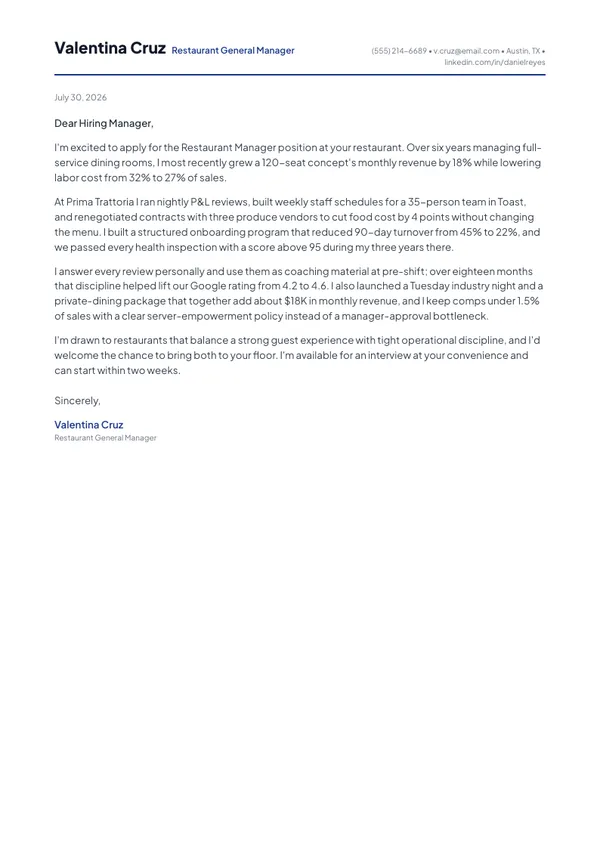
Restaurant Manager
Compact template
View example →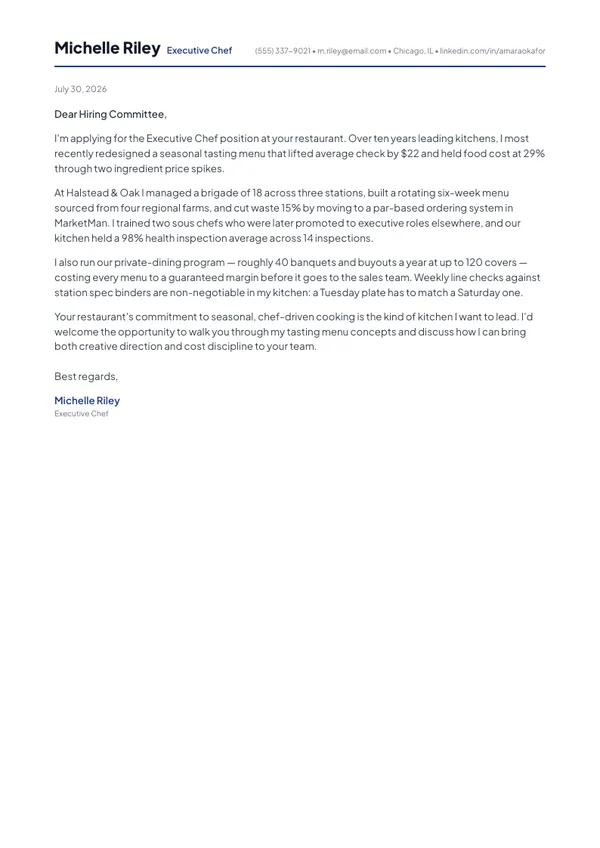
Executive Chef
Compact template
View example →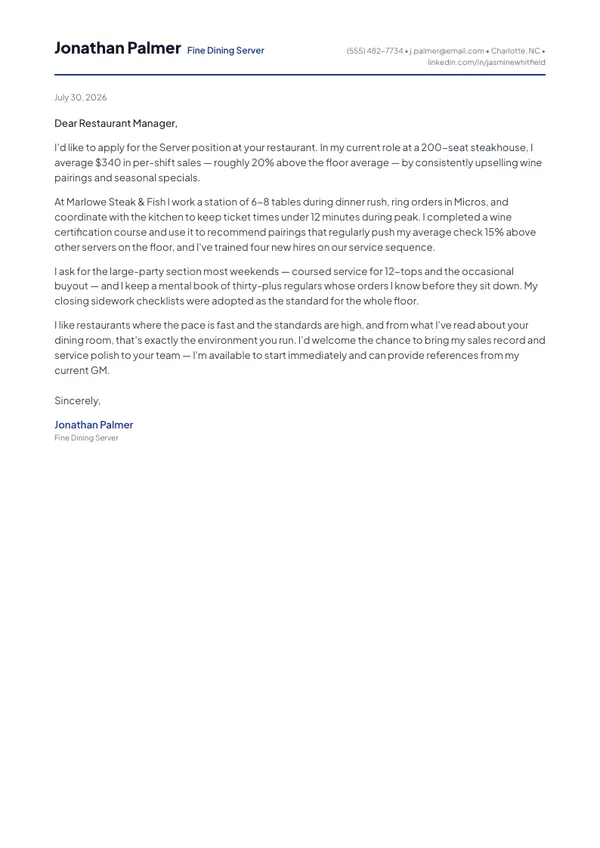
Server
Compact template
View example →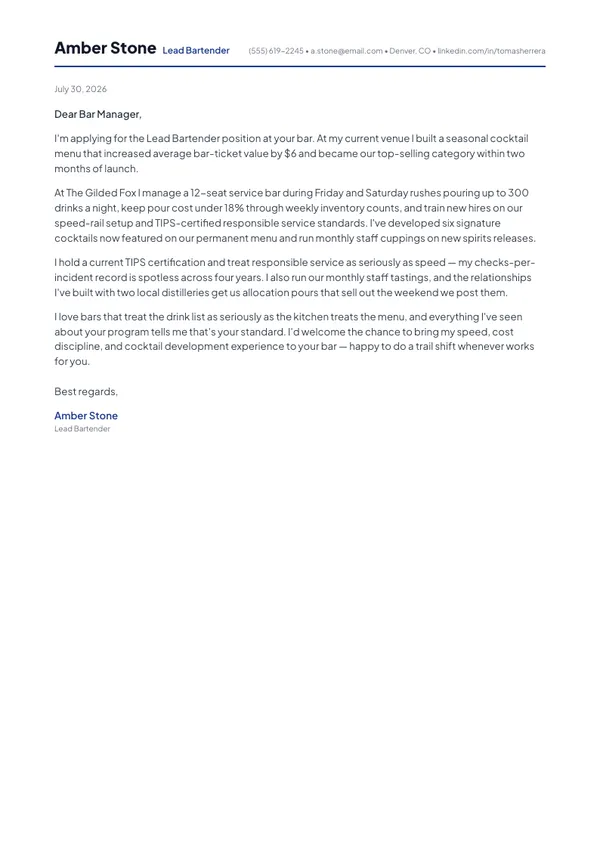
Bartender
Compact template
View example →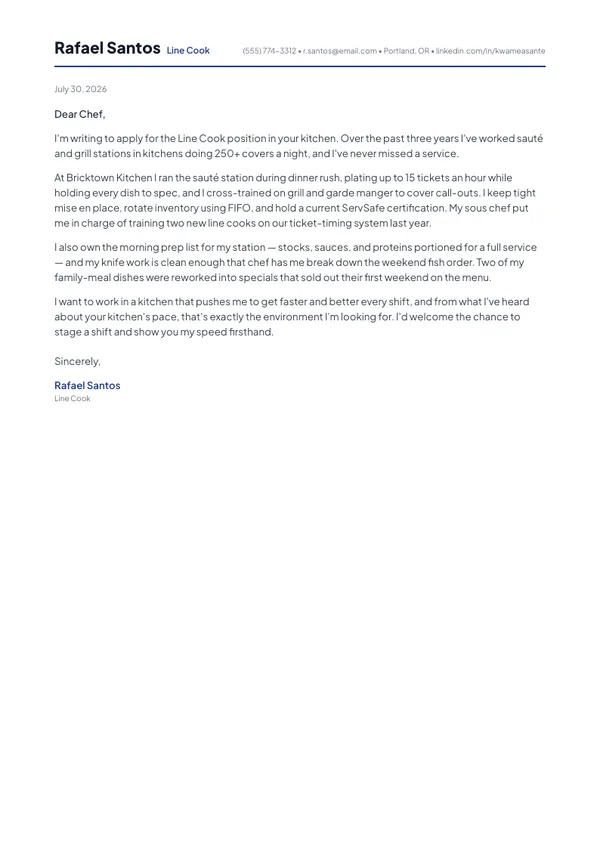
Line Cook
Compact template
View example →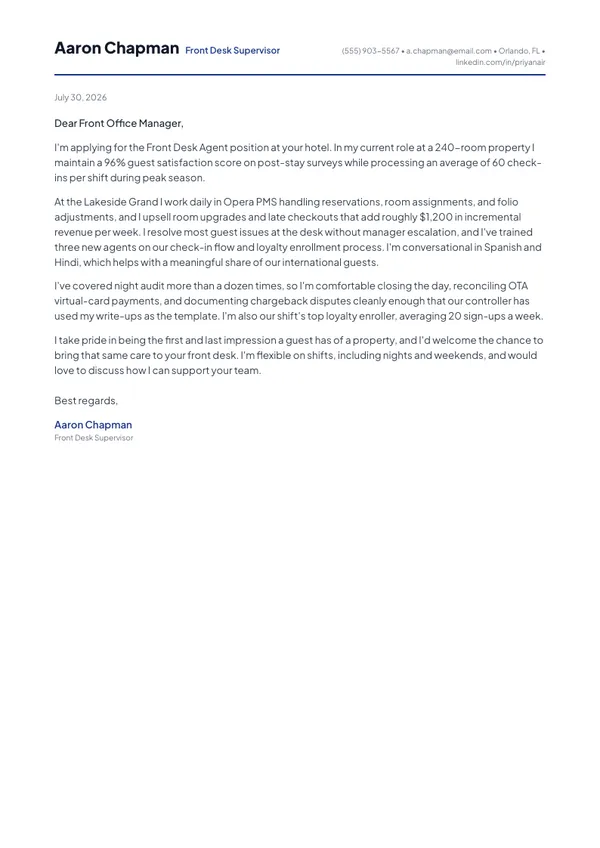
Hotel Front Desk Agent
Compact template
View example →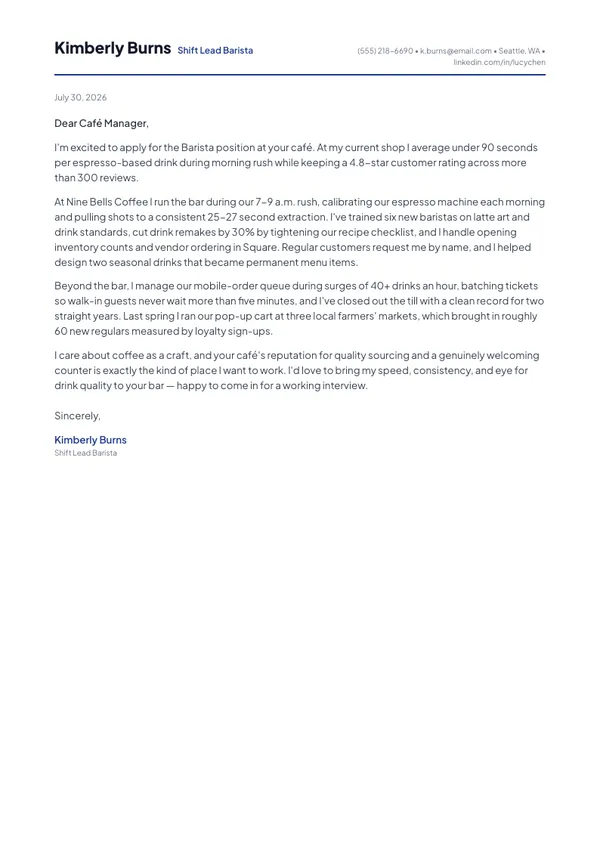
Barista
Compact template
View example →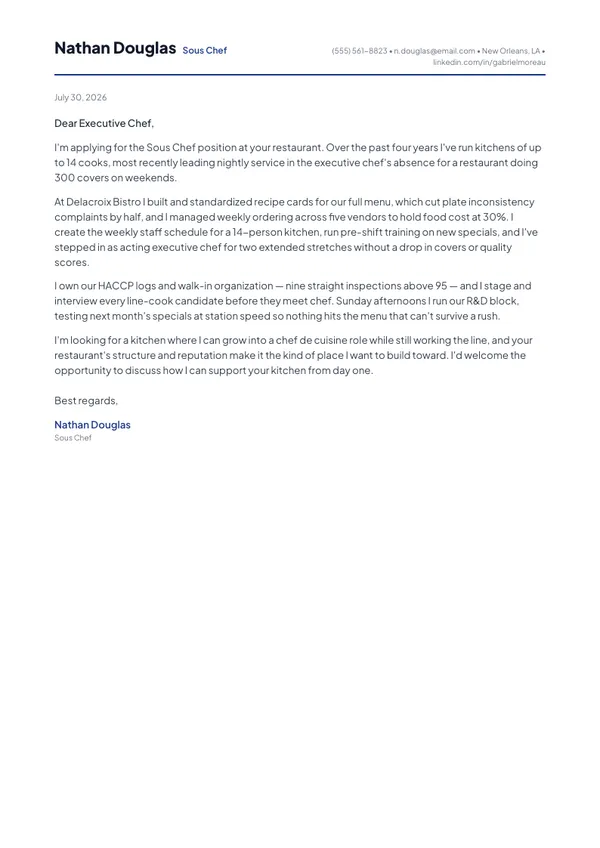
Sous Chef
Compact template
View example →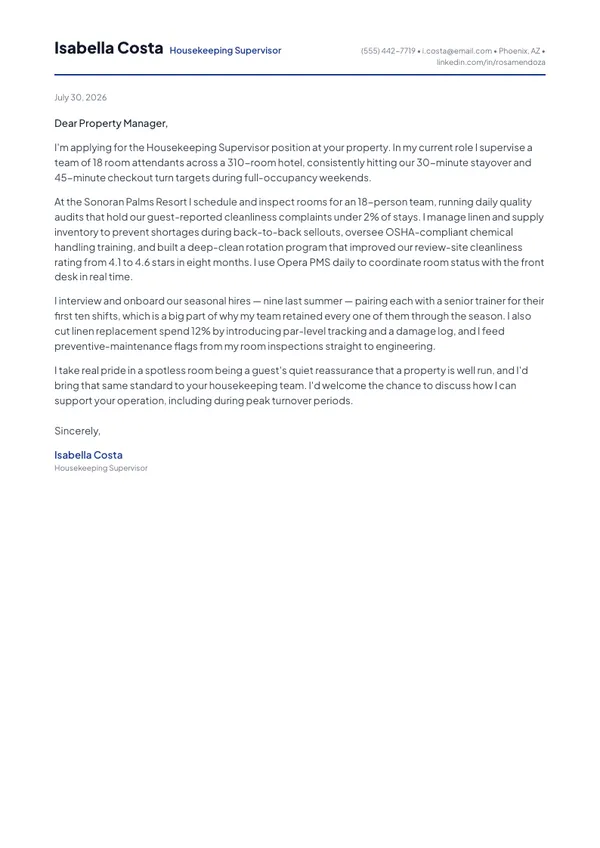
Housekeeping Supervisor
Compact template
View example →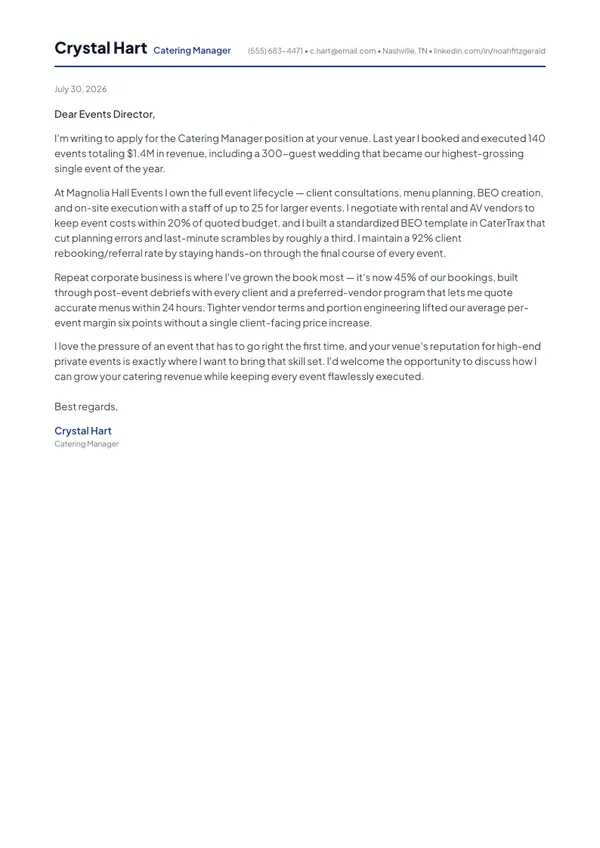
Catering Manager
Compact template
View example →What a hospitality & restaurant cover letter has to prove
You have worked the volume they work
Covers per service, drinks per night, rooms turned per shift, tickets per hour. A kitchen doing 300 covers on a Saturday needs to know you have seen 300 covers on a Saturday.
You show up
Reliability is the single biggest hiring risk in hospitality. Attendance records, tenure, "never missed a service", picking up shifts — these carry more weight here than in any other industry, and almost nobody mentions them.
You move the numbers a manager is measured on
Food cost, pour cost, labour percentage, average check, upsell revenue, guest satisfaction score. Managers are held to these; showing you understand them signals you think like the person hiring you.
You hold the certifications the role legally needs
ServSafe, TIPS, food handler cards, allergen training. Name them explicitly and note whether they are current — a hiring manager should never have to ask.
You can take feedback in the middle of a rush
Kitchens and dining rooms run on direct, immediate correction. A line about training new hires or taking a correction without friction tells a chef more about your fit than any adjective.
You have read the menu
One specific, accurate sentence about their concept, sourcing, or a dish beats three paragraphs of enthusiasm. It is also the fastest way to prove the letter is not a template you sent to forty venues.
How to structure it
- 1
Open with the role and your strongest number
Name the exact position and follow it with one quantified fact — covers, check average, uptime, review score. No "I am writing to apply".
- 2
Prove the volume and the station
Where you worked, what you ran, how busy it was. This is the paragraph that decides whether you get a trail shift.
- 3
Show the operational side
Inventory, ordering, scheduling, training, cost control, health inspections. Even for line-level roles, one sentence here separates you from candidates who only describe their shift.
- 4
Close with the venue and a concrete offer
One accurate observation about their restaurant or property, then an explicit next step — offer to stage a shift, note your availability, confirm you can work nights and weekends.
Questions people ask
Do restaurants actually read cover letters?
Many do, and in hospitality the letter often matters more than elsewhere because resumes in this industry look almost identical — the same venues, the same job titles, the same duties. The letter is where you show covers per shift, reliability and specific knowledge of their concept, none of which fit neatly on a resume. For salaried roles (manager, chef, supervisor) it is close to expected. For hourly roles it is optional but rare enough that sending one puts you in a small group.
How long should a restaurant cover letter be?
Three or four short paragraphs, comfortably under one page. Hospitality managers read applications between services, not at a desk. A letter that runs to a full page of dense text is more likely to be skimmed to the first number and abandoned. Every example on this page fits on one page with room to spare.
What if I have no restaurant experience?
Lead with the transferable pressure, not an apology for the gap. Retail at Christmas, event work, catering shifts, volunteering in a busy kitchen — all demonstrate throughput and standing for eight hours. Then be direct about wanting to learn the station, and offer to stage a shift. Managers hire for attitude and reliability at entry level far more than for a specific CV line.
Should I mention my certifications in the cover letter or just the resume?
Both. ServSafe, TIPS, food handler and allergen certifications are frequently a legal precondition rather than a nice-to-have, and a manager scanning for them should find them without hunting. Name them in the body with their status — "current ServSafe" beats "ServSafe" — and keep them on the resume as well.
Is the same letter fine for a server job and a line cook job?
No, and it is usually obvious. Front of house is judged on guest interaction, upselling and check average; back of house on station speed, consistency and food cost. The numbers that impress one barely register with the other. Start from the example for the specific role below rather than editing a generic letter.
Start from one of these hospitality & restaurant letters
Pick the example closest to your role, open it in the builder, and replace the details with your own.